

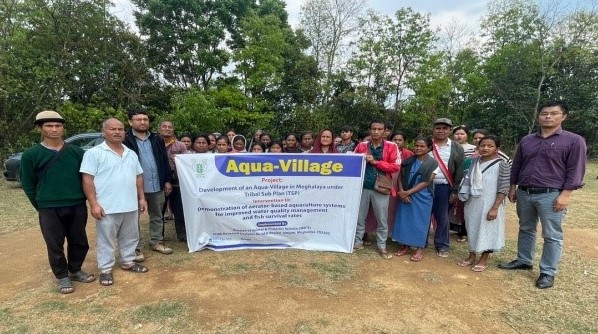
As part of the ongoing initiative to establish a model Aqua-Village at Mawdwar village,
Ri Bhoi District, Meghalaya, the Division of Animal and Fisheries Sciences (DAFS), ICAR Research Complex for NEH Region, Umiam, conducted
the third phase of its phased training programme from 13 to 16 March 2026. The programme was implemented under the Tribal Sub-Plan (TSP) and
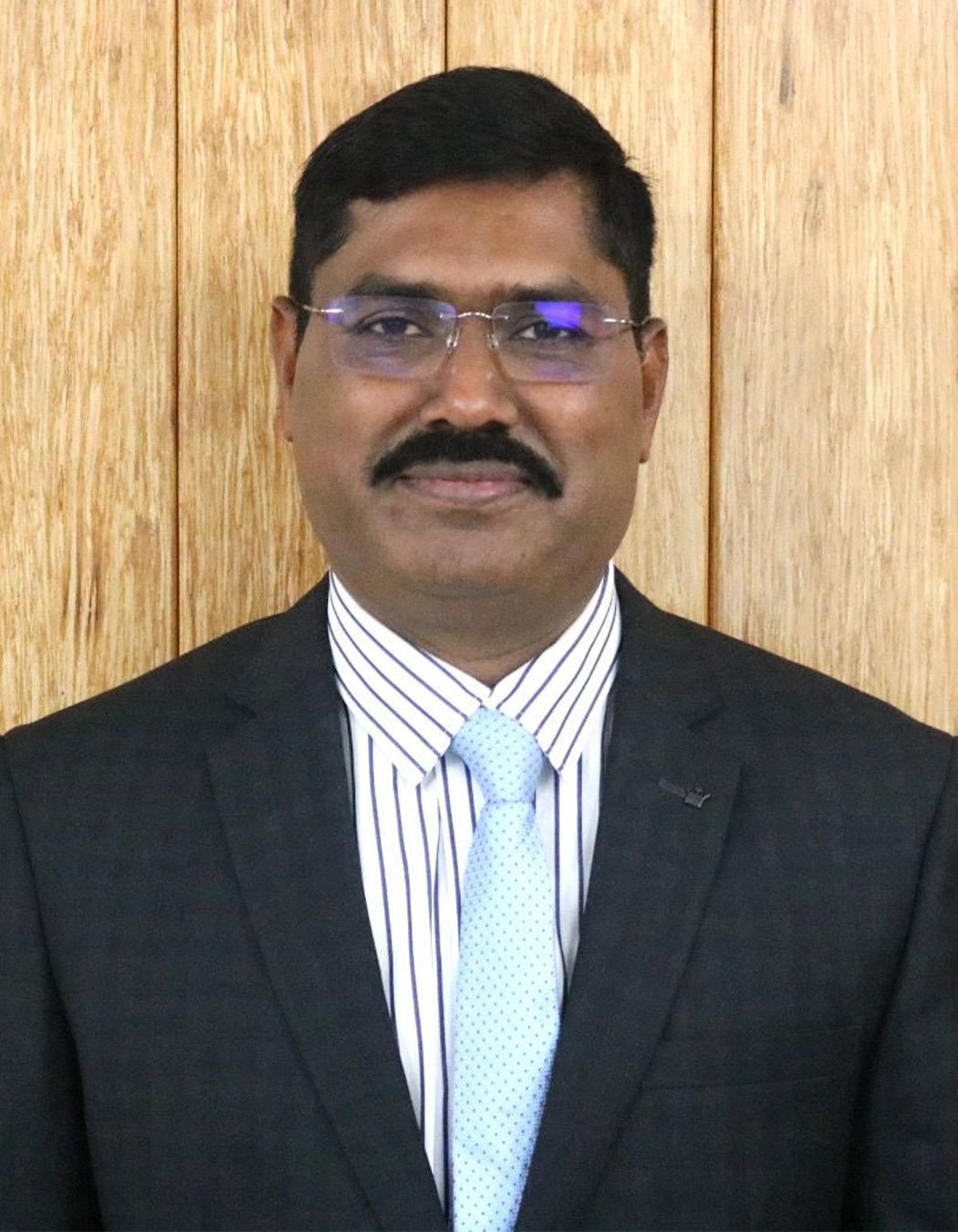
was conducted under the overall guidance of Dr. S. Ghatak, Director, ICAR Research Complex for NEH Region, Meghalaya.
To assess the impact of the training, a baseline survey was conducted using a structured
questionnaire prior to the interventions, which will serve as a reference for evaluating knowledge gain and behavioural change among participants
following the programme.
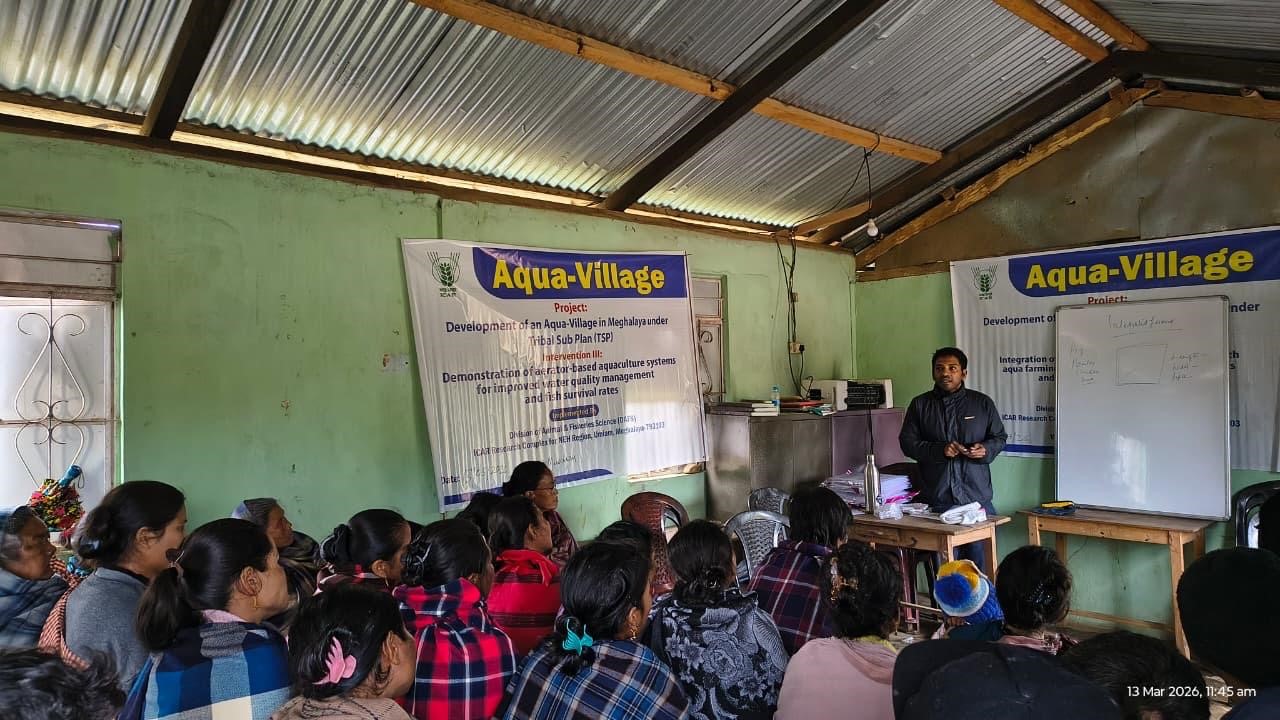
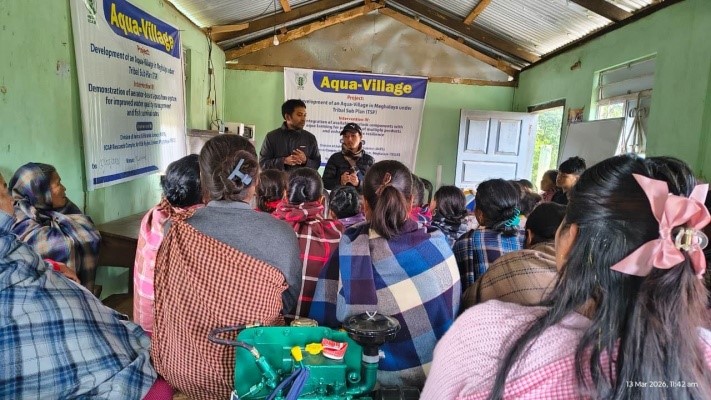
The third phase training comprised two key interventions. Intervention III
focused on the demonstration of aerator-based aquaculture systems for improved water quality management and enhanced fish survival rates,
while Intervention IV addressed the integration of available livestock components with aqua farming for the production of multiple products
and improved climate resilience. A total of 30 farmers participated in the programme - 15 under each intervention.
The training was delivered by a team of experienced resource persons over three days.
On the first day, Dr. C. Debnath, Senior Scientist, and Mr. P.J. Ryntathiang led the sessions. The second day's sessions were handled by
Mr. S.S. Sumer and Mrs. I. Wahlang, while the third day's training was conducted by Mr. A. Lenin Singh, Scientist, and Mr. P. Mahanta, Technical Officer (Fisheries).
During the three days, farmers were imparted practical knowledge on various integrated farming
systems, including fish-pig, fish-chicken, fish-duck, and paddy--fish farming. Special emphasis was also placed on the productive utilization of
pond dikes, which typically remain vacant and underutilized. Farmers were trained on how these areas can be effectively used for cultivating diverse
agri-horticultural crops by constructing trellises using locally available materials such as bamboo or wood. This approach not only enables efficient
use of available land resources but also opens additional avenues for income generation and employment opportunities for farming households.
The programme was coordinated by Dr. C. Debnath and Mr. S. Gojendro Singh, Scientist SS, with
logistical support from Mr. P. Mahanta, Technical Officer, DAFS. This third phase of training further strengthens the foundation of the Aqua-Village
model, which is envisioned as a replicable framework for promoting scientific aquaculture and sustainable livelihoods in tribal communities of Meghalaya.
 |
 |
 |
 |